Skip to main content
Contents Index
Search Book
Search Results:
No results.
Read aloud Readability settings Prev Up Next \(\newcommand{\identity}{\mathrm{id}}
\newcommand{\Null}{\operatorname{Null}}
\newcommand{\ds}{\displaystyle}
\newcommand{\ve}{\varepsilon}
\newcommand{\Qq}{\mathbb{Q}}
\DeclareMathOperator{\asec}{arcsec}
\pgfplotsset{compat=1.18}
\newcommand{\lt}{<}
\newcommand{\gt}{>}
\newcommand{\amp}{&}
\definecolor{fillinmathshade}{gray}{0.9}
\newcommand{\fillinmath}[1]{\mathchoice{\colorbox{fillinmathshade}{$\displaystyle \phantom{\,#1\,}$}}{\colorbox{fillinmathshade}{$\textstyle \phantom{\,#1\,}$}}{\colorbox{fillinmathshade}{$\scriptstyle \phantom{\,#1\,}$}}{\colorbox{fillinmathshade}{$\scriptscriptstyle\phantom{\,#1\,}$}}}
\)
Introduction
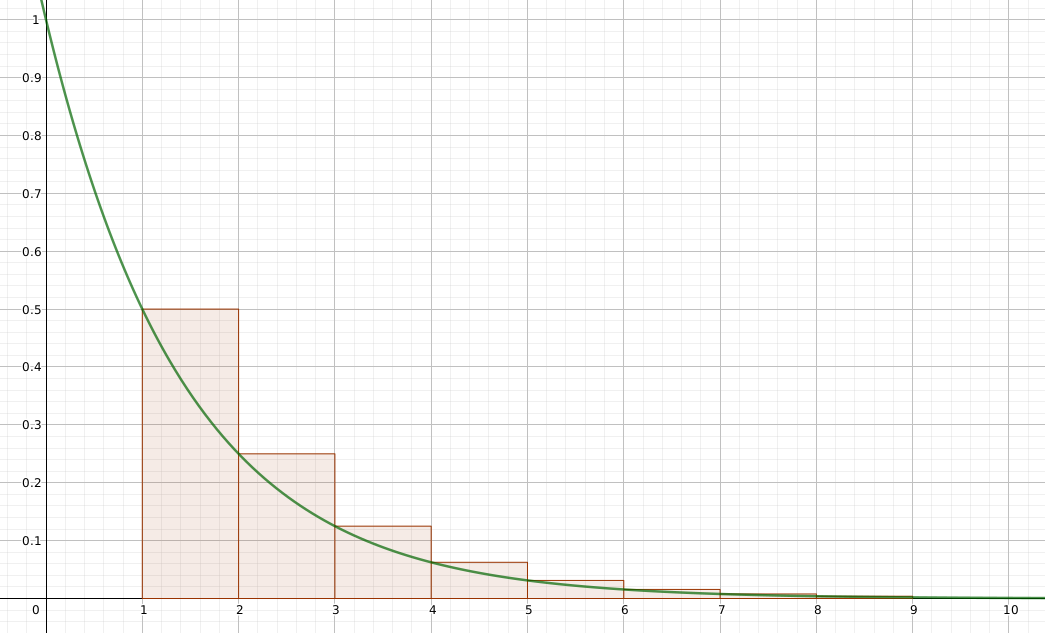
The definite integrals that we have dealt with so far involve bounded integrands on bounded intervals. Does it make sense to relax one or both of these requirements? For example, does it make sense to consider the integral of the function
\(f(x)=1/2^{x}\) on the unbounded interval
\([1,\infty)\text{?}\) Intuitively, a definite integral is some sort of "area" and so the following picture suggests
The graph of one over two to the power x and rectangles representation the sum of one over two to the power n.
Figure 4.1. Comparing the area underneath the graph of \(1/2^x\) with the sum of the geometric series \(\sum_{n=1}^{\infty} 1/2^n\)
\begin{equation*}
0 \lt \int_1^{\infty} \frac{1}{2^x} dx \le \frac{1}{2} + \frac{1}{2^2}
+ \frac{1}{2^3} + \cdots = 1.
\end{equation*}
and so, the integral should be a number less than \(1\text{.}\)