Skip to main content
Contents Index
Search Book
Search Results:
No results.
Read aloud Readability settings Prev Up Next \(\newcommand{\identity}{\mathrm{id}}
\newcommand{\Null}{\operatorname{Null}}
\newcommand{\ds}{\displaystyle}
\newcommand{\ve}{\varepsilon}
\newcommand{\Qq}{\mathbb{Q}}
\DeclareMathOperator{\asec}{arcsec}
\pgfplotsset{compat=1.18}
\newcommand{\lt}{<}
\newcommand{\gt}{>}
\newcommand{\amp}{&}
\definecolor{fillinmathshade}{gray}{0.9}
\newcommand{\fillinmath}[1]{\mathchoice{\colorbox{fillinmathshade}{$\displaystyle \phantom{\,#1\,}$}}{\colorbox{fillinmathshade}{$\textstyle \phantom{\,#1\,}$}}{\colorbox{fillinmathshade}{$\scriptstyle \phantom{\,#1\,}$}}{\colorbox{fillinmathshade}{$\scriptscriptstyle\phantom{\,#1\,}$}}}
\)
Section A.3 Factoring Quadratics
Subsection A.3.1 Overview
Let
\(q(x)=ax^2+bx+c\) with
\(a\neq 0\text{.}\) Over the rational numbers
\(\Qq\text{,}\) a common strategy is to split the middle term and then factor by grouping. This is often called the
diamond method .
Look for numbers \(m,n\in\Qq\) such that
\begin{equation*}
m+n=b, \qquad mn=ac.
\end{equation*}
Then rewrite
\begin{equation*}
ax^2+bx+c=ax^2+mx+nx+c
\end{equation*}
and factor by grouping. If no such rational \(m,n\) exist, this method does not produce a factorization over \(\Qq\text{.}\)
Example A.5 .
Factor
\(x^2-7x+12\) over
\(\Qq\text{.}\)
We need \(m+n=-7\) and \(mn=12\text{.}\) Choose \(m=-3,\ n=-4\text{.}\) Then
\begin{equation*}
x^2-7x+12=x^2-3x-4x+12
=x(x-3)-4(x-3)
=(x-3)(x-4).
\end{equation*}
Example A.6 .
Factor
\(6x^2+x-2\) over
\(\Qq\text{.}\)
Now \(ac=6(-2)=-12\text{.}\) We need \(m+n=1\) and \(mn=-12\text{.}\) Choose \(m=4,\ n=-3\text{.}\) Then
\begin{equation*}
6x^2+x-2=6x^2+4x-3x-2
=2x(3x+2)-1(3x+2)
=(2x-1)(3x+2).
\end{equation*}
Theorem A.7 . Real Factorization Criterion.
For a quadratic \(p(x)=ax^2+bx+c\) with real coefficients and \(a\neq 0\text{,}\) the following are equivalent:
\(p(x)\) factors over \(\mathbb{R}\text{.}\)
\(p(x)\) has a real root.
The discriminant \(\Delta=b^2-4ac\) satisfies \(\Delta\ge 0\text{.}\)
Proof.
\((1)\Rightarrow(2)\text{:}\) if
\(p(x)=a(x-r)(x-s)\) with
\(r,s\in\mathbb{R}\text{,}\) then
\(p(r)=0\text{.}\)
\((2)\Rightarrow(1)\text{:}\) if
\(p(r)=0\) for some
\(r\in\mathbb{R}\text{,}\) then
\(x-r\) divides
\(p(x)\text{,}\) so
\(p(x)=(x-r)(ax+d)=a(x-r)\left(x+\frac{d}{a}\right)\text{.}\)
\((2)\Leftrightarrow(3)\text{:}\) by the quadratic formula,
\begin{equation*}
x=\frac{-b\pm\sqrt{b^2-4ac}}{2a},
\end{equation*}
roots are real exactly when \(b^2-4ac\ge 0\text{.}\)
Example A.8 .
Factor
\(2x^2+x-3\) by finding roots.
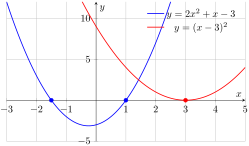
The discriminant is \(\Delta=1-4(2)(-3)=25\gt 0\text{,}\) so there are two real roots:
\begin{equation*}
x=\frac{-1\pm 5}{4} \in \left\{1,-\frac{3}{2}\right\}.
\end{equation*}
Hence
\begin{equation*}
2x^2+x-3=2(x-1)\left(x+\frac{3}{2}\right)=(2x+3)(x-1).
\end{equation*}
Example A.9 .
Factor
\(x^2-6x+9\) by finding roots.
Here \(\Delta=(-6)^2-4(1)(9)=0\text{,}\) so the root is repeated: \(x=3\text{.}\) Therefore
\begin{equation*}
x^2-6x+9=(x-3)^2.
\end{equation*}
Figure A.10. Quadratics with two distinct roots and a repeated root.
The graph shows the discriminant picture: crossing the
\(x\) -axis corresponds to two real roots (
\(\Delta\gt 0\) ), tangency corresponds to one repeated real root (
\(\Delta=0\) ), and no intersection would correspond to
\(\Delta\lt 0\text{.}\)